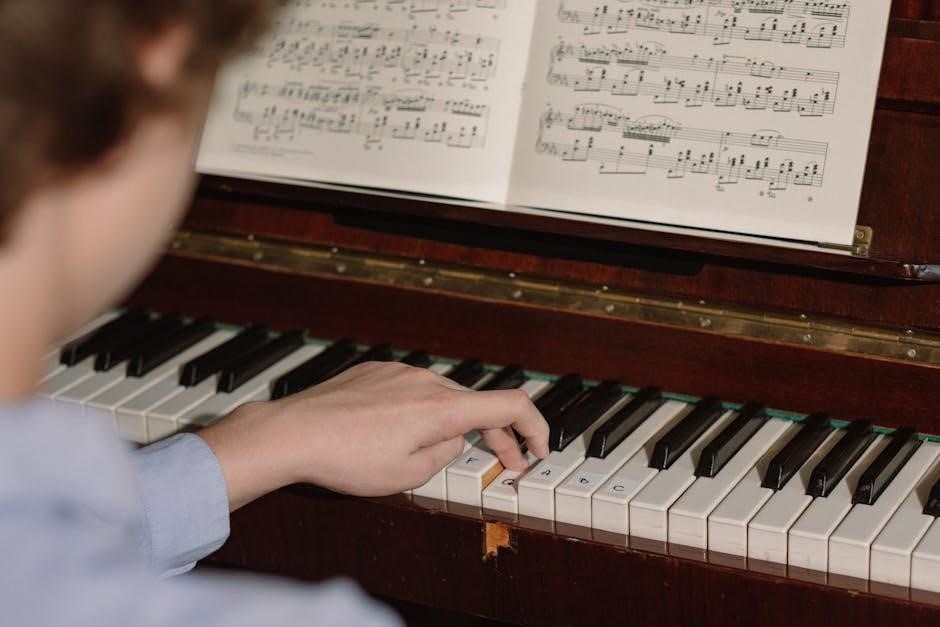
Piano technique relies heavily on mastering scales, and readily available PDF resources offer detailed fingerings for various keys.
Interactive tools and technique books further enhance learning, providing visual aids and structured practice routines for optimal dexterity.
Understanding correct fingering is crucial for smooth transitions and efficient playing, unlocking musical expression and technical proficiency on the piano.
What are Piano Scales?
Piano scales are a fundamental building block of music, representing a sequence of notes arranged in a specific order, typically ascending or descending. They form the melodic and harmonic basis for countless pieces, and mastering them is essential for any pianist.
Essentially, a scale defines a key – the tonal center around which a piece of music revolves. Understanding scales allows musicians to improvise, compose, and analyze music with greater depth. Many resources, including readily available PDF documents, illustrate these note sequences.
These PDFs often include fingerings, assigning specific fingers to each note to facilitate smooth and efficient playing. The fingerings are crucial for developing proper technique and avoiding tension. They are often numbered, with 1 representing the thumb and 5 representing the pinky finger.
Scales aren’t just about memorizing notes; they’re about internalizing the relationships between them. Practicing scales with correct fingerings builds muscle memory and improves coordination, ultimately enhancing a pianist’s overall musicality. Digital piano applications also provide interactive scale practice.
Why are Fingerings Important?
Correct fingerings are paramount in piano playing, directly impacting technique, speed, and musicality. They aren’t arbitrary; they’re carefully designed to optimize hand position and minimize unnecessary movement. Utilizing the correct fingerings, often found in PDF charts, allows for smoother transitions between notes and scales.
Without proper fingerings, playing can become awkward, slow, and prone to errors. Incorrect choices can lead to tension, hindering both technical proficiency and expressive playing. Many PDF resources dedicate themselves to providing optimal fingerings for various scales and arpeggios.
The numbered system – 1 for the thumb, 2 for the index, and so on – is universally used in these charts. Consistent application of these fingerings builds muscle memory, allowing the pianist to execute passages with greater fluency and accuracy.
Furthermore, efficient fingerings enable pianists to navigate complex pieces with ease, freeing them to focus on musical interpretation rather than struggling with technical challenges. Interactive piano tools also reinforce correct finger placement.

Major Scales and Fingerings
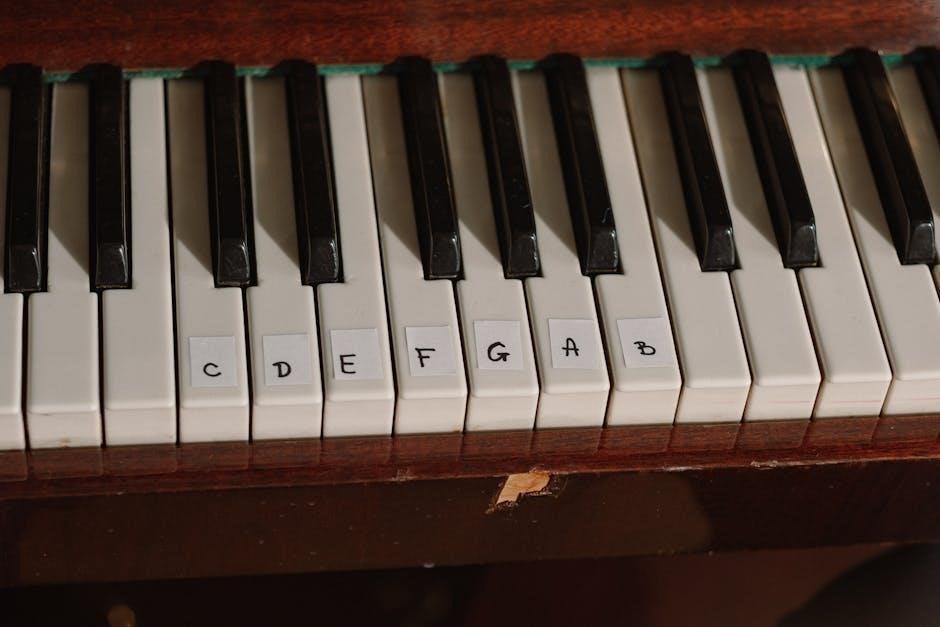
Major scales, foundational to piano study, are often presented with specific fingerings in PDF format for efficient practice and technical development.
C Major Scale ⎼ Fingerings for Right and Left Hand
C Major, devoid of sharps or flats, serves as the cornerstone for learning piano scales, and numerous PDF resources detail its fingerings meticulously.
For the right hand, a common fingering pattern is 1-2-3-1-2-3-4-5, ascending. This means starting with the thumb (1) on C, then index (2) on D, middle (3) on E, thumb (1) on F, index (2) on G, middle (3) on A, ring (4) on B, and pinky (5) on high C.
Descending, the pattern reverses: 5-4-3-2-1-3-2-1; The left hand typically employs 5-4-3-2-1-3-2-1 ascending, beginning with the pinky (5) on C. Descending mirrors this: 1-2-3-1-2-3-4-5.
Many PDF charts visually represent these fingerings alongside the musical notation, aiding memorization. Consistent practice with these fingerings builds muscle memory and facilitates smoother transitions between notes, crucial for more complex pieces. Digital piano score PDFs often include these markings.
G Major Scale ⎯ Fingerings and Common Challenges
The G Major scale, featuring one sharp (F#), presents unique fingering challenges for piano students, often detailed in PDF instructional materials.
A standard right-hand fingering is 2-3-1-2-3-4-5, starting with the index finger (2) on G. This avoids an awkward thumb tuck under. Descending utilizes 5-4-3-2-1-3-2. The left hand commonly uses 3-2-1-3-2-1-2-3 ascending, beginning with the middle finger (3) on G. Descending mirrors this pattern.
A common difficulty lies in the transition between the 3rd and 4th fingers, requiring deliberate practice for smoothness. Many PDF resources highlight this area. Students also struggle with maintaining consistent hand position throughout the scale.
Online interactive tools and technique books with fingering charts can aid in overcoming these hurdles. Consistent, slow practice, referencing PDF guides, is key to mastering the G Major scale and building a solid technical foundation.
D Major Scale ⎼ Fingerings and Practice Tips
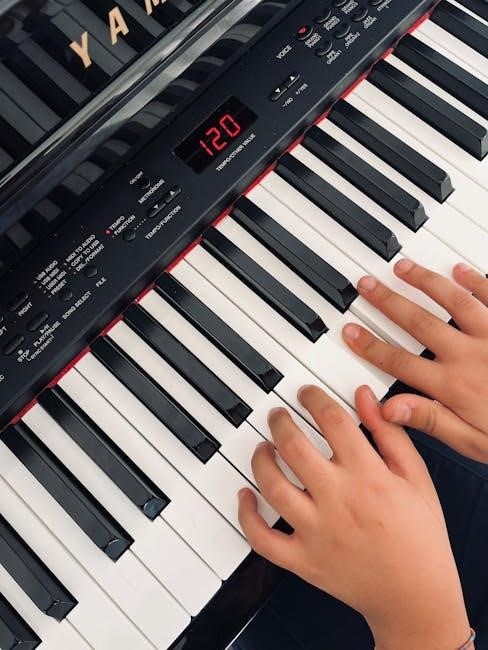
The D Major scale, with two sharps (F# and C#), is a foundational element in piano technique, often presented with detailed fingerings in PDF resources.
Right-hand fingering typically follows 2-1-2-3-1-2-3, starting with the index finger (2) on D. The left hand commonly employs 3-2-1-3-2-1-2-3, beginning with the middle finger (3) on D. These patterns, readily available in PDF charts, promote efficient hand movement.
Practice tips emphasize slow, deliberate repetitions, focusing on evenness of tone and rhythm. Utilizing a metronome, as suggested in many technique books, ensures consistent tempo. Pay close attention to the thumb tuck under, a common area for tension.
PDF guides often include exercises for isolating challenging transitions. Regularly reviewing fingering charts and incorporating online interactive tools will accelerate learning and build a strong technical base for playing the D Major scale.
A Major Scale ⎼ Fingerings and Hand Positioning
The A Major scale, containing three sharps (F#, C#, and G#), demands precise fingering for fluid execution, often detailed in comprehensive piano scale PDFs.
Right-hand fingering generally follows 1-2-3-1-2-3-4-5, initiating with the thumb (1) on A. The left hand typically utilizes 5-4-3-2-1-3-2-1, starting with the pinky (5) on A. These patterns, easily found in PDF charts, optimize hand positioning.
Correct hand positioning is vital. Maintain a relaxed, curved hand shape, avoiding tension in the wrists and fingers. Ensure the elbows are slightly away from the body, promoting freedom of movement. PDF resources often illustrate ideal hand posture.
Practice slowly, focusing on accurate fingering and even tone. Utilize online tools alongside PDF guides to visualize and reinforce correct technique. Consistent practice builds muscle memory and enhances technical proficiency in the A Major scale.
E Major Scale ⎼ Fingerings and Avoiding Tension
The E Major scale, featuring four sharps (F#, C#, G#, and D#), presents a challenge for maintaining relaxation, often addressed in detailed piano scale PDFs.
Standard right-hand fingering is 1-2-3-1-2-3-4-5, beginning with the thumb (1) on E. The left hand commonly employs 5-4-3-2-1-3-2-1, starting with the pinky (5) on E. These fingerings, readily available in PDF format, facilitate smoother transitions.
Avoiding tension is paramount. Pay close attention to the shoulders, arms, and hands. Regularly check for tightness and consciously release it. A curved hand shape and flexible wrists are crucial. Many PDF resources emphasize relaxation techniques.
Slow, deliberate practice is key. Focus on each note and transition, ensuring a relaxed and even sound. Utilize metronome practice, guided by PDF exercises, to build consistency and prevent tension from creeping in. Consistent practice builds technique.
Minor Scales and Fingerings
PDF resources detail fingerings for natural, harmonic, and melodic minor scales, showcasing unique intervals and patterns for efficient piano practice.
Mastering these scales unlocks expressive possibilities and technical fluency, as demonstrated in comprehensive piano technique PDF guides.
Natural Minor Scales ⎯ Fingerings Explained
Natural minor scales, foundational in piano study, present distinct fingering patterns readily available in numerous PDF resources. These charts typically illustrate two-octave patterns, emphasizing smooth transitions and efficient hand positioning. For instance, the A natural minor scale (no sharps or flats) often begins with the 1st finger on A in the right hand, progressing through 2-3-1-2-3-4-1.
Left-hand fingerings often mirror this approach, starting with the 5th finger on A. PDF guides frequently highlight these patterns visually, aiding memorization. Understanding these fingerings is crucial because they form the basis for more complex minor scale variations. Many resources, like “Piano Ology,” provide clear diagrams.
Consistent practice with these fingerings builds muscle memory, enabling effortless execution. Remember to focus on evenness of tone and rhythm while utilizing the suggested fingerings found in downloadable PDF documents. These resources often include both ascending and descending patterns, ensuring comprehensive learning. The goal is to internalize these patterns for fluid improvisation and composition.
Harmonic Minor Scales ⎯ Fingerings and Characteristic Intervals
Harmonic minor scales introduce a raised 7th degree, creating a distinctive sound and impacting fingering choices. PDF resources dedicated to piano scales demonstrate these patterns, often highlighting the augmented second interval between the 6th and 7th degrees. For example, in A harmonic minor, the fingering might begin 1-2-3-1-2-3-4-5 in the right hand, accommodating the raised G#.
Left-hand fingerings similarly adjust to navigate this interval, frequently utilizing a thumb tuck or crossover. Charts available as PDF files often visually depict these adjustments. Mastering these fingerings is vital, as the harmonic minor scale is prevalent in classical and romantic repertoire. Resources like those detailing “Fingering Chart for the C…” demonstrate these nuances.
Pay close attention to the characteristic interval; smooth execution requires deliberate practice. Downloadable PDFs provide a structured approach to learning these scales, ensuring accurate fingering and a clear understanding of the harmonic implications. Consistent practice builds fluency and musicality.
Melodic Minor Scales ⎯ Ascending and Descending Fingerings
Melodic minor scales present a unique challenge: differing fingerings for ascending and descending passages. PDF resources specializing in piano scales clearly illustrate these variations. Ascending, the 6th and 7th degrees are raised, requiring adjusted fingerings to navigate smoothly. For instance, C melodic minor ascending might start 1-2-3-1-2-3-4-5. Descending, these degrees revert to their natural form, necessitating a different fingering pattern.
Many PDF charts, like those found in “Piano Ology Piano Technique Fingering Charts,” provide both ascending and descending patterns side-by-side for easy comparison. The goal is to achieve a lyrical quality, avoiding awkward shifts. Online interactive tools can also aid in visualizing these fingerings.
Consistent practice, utilizing downloadable PDFs, is key to internalizing these patterns. Focus on smooth transitions between ascending and descending forms, ensuring accurate fingering and a musical interpretation.

Chromatic Scale Fingerings
PDF resources detail systematic fingerings for the chromatic scale, utilizing all twelve tones. Right and left-hand patterns differ, emphasizing smooth, even execution on the piano.
Chromatic Scale ⎼ Right Hand Fingering Pattern
Chromatic scale right-hand fingering typically begins with the thumb (1) on a white key, progressing sequentially through all twelve tones. A common pattern, often found in piano technique PDFs, is 1-2-3-1-2-3-4-1. This sequence repeats across octaves, ensuring consistent hand positioning and minimizing awkward shifts.
Many resources emphasize maintaining a curved finger shape and relaxed wrist to facilitate smooth transitions. The pattern prioritizes efficient use of each finger, avoiding unnecessary tension. Some variations exist, particularly when navigating black keys, but the core principle of sequential fingering remains consistent.
PDF charts often visually represent this pattern, clearly indicating finger numbers above each note. Practicing slowly with a metronome is crucial for internalizing the fingering and developing evenness. Mastering this pattern builds dexterity and prepares the hand for more complex passages. Consistent practice with these fingerings is key to technical proficiency.
Chromatic Scale ⎯ Left Hand Fingering Pattern

The left-hand chromatic scale fingering generally starts with the pinky (5) on a white key, moving downwards through all twelve semitones. A frequently cited pattern, detailed in many piano PDF resources, is 5-4-3-2-1-3-2-1. This sequence repeats across octaves, promoting a balanced hand position and minimizing strain.
Similar to the right hand, maintaining a relaxed wrist and curved fingers is vital for fluid execution. The pattern aims for efficient finger usage, avoiding unnecessary movements. Some adjustments may be needed when encountering black keys, but the fundamental sequential fingering remains consistent.
PDF charts commonly illustrate this pattern with finger numbers positioned above each note. Slow, metronomic practice is essential for memorizing the fingering and achieving evenness. Mastering this pattern enhances dexterity and prepares the hand for more challenging musical phrases. Consistent practice with these fingerings is paramount.

Resources for Piano Scales with Fingerings (PDF)
Numerous free PDF resources detail major and minor scales with fingerings; online interactive tools aid learning, while technique books offer comprehensive piano guidance.
Free PDF Resources for Major and Minor Scales
Finding readily accessible PDF documents containing piano scales and their corresponding fingerings is remarkably easy. Several websites offer comprehensive collections, often categorized by key and scale type – major, natural minor, harmonic minor, and melodic minor.
Piano Ology provides a free download of major scale fingering charts, while other sources compile scales in all major keys, spanning two octaves with clear fingering indications. These resources typically present right-hand fingerings above the staff and left-hand fingerings below, using standard numbering (1 for thumb, 2 for index, and so on).
Digital Piano Score offers scales in all major keys, also with fingerings. Many PDFs focus on harmonic minor scales, detailing fingering for both hands across two octaves. Remember to check for enharmonic keys listed only once to avoid redundancy. These free resources are invaluable for students and pianists seeking to solidify their scale technique and understanding of piano theory.
Online Interactive Piano Scale Tools
Beyond static PDFs, numerous online tools provide an interactive experience for learning piano scales and fingerings. These platforms often feature virtual keyboards where you can visualize scales and experiment with different fingerings in real-time.
One notable project is a JavaScript-driven piano application offering information on 28 different scales across all keys. These tools frequently highlight the correct fingering for each note, allowing users to practice alongside visual cues. Some platforms even offer audio playback, enabling you to hear the scale played correctly.
Interactive features may include customizable tempo settings and the ability to focus on specific sections of a scale. These tools complement PDF resources by providing a dynamic and engaging way to reinforce learning and develop muscle memory. They are particularly useful for identifying and correcting incorrect fingerings.
Piano Technique Books with Scale Fingerings
Traditional piano technique books remain invaluable resources for mastering scales and fingerings, often providing a more comprehensive approach than solely relying on PDF downloads. These books typically present scales systematically, progressing in difficulty and covering major, minor, and chromatic scales.
They meticulously detail correct fingerings for both hands, often including variations for different octaves and positions. Many books also incorporate exercises designed to reinforce proper technique and build finger strength. Alongside fingerings, these resources frequently offer guidance on hand position, posture, and musicality.
Piano Ology’s fingering charts, available online, exemplify the type of detailed information found in these books. While PDFs offer convenience, technique books provide a structured learning path and often include supplementary material like arpeggios and chord progressions, enhancing overall musical development.

Tips for Practicing Scales with Correct Fingerings
Consistent, slow practice with a metronome builds accuracy and muscle memory, while focusing on relaxed hand positions prevents tension during scale execution;
Slow Practice and Accuracy
Prioritizing slow practice is paramount when learning piano scales with correct fingerings. Resist the urge to rush; accuracy at a slower tempo builds a solid foundation for speed later on. Begin by isolating short segments of the scale – perhaps just one octave – and focus intently on each finger placement.
Referencing PDF resources displaying finger numbers can be incredibly helpful during this stage. Visually confirming the correct fingering reinforces the connection between the note and the appropriate finger. Pay close attention to thumb tucks and finger crossings, ensuring smooth transitions between notes.
Accuracy isn’t simply about playing the right notes; it’s about playing them with the correct technique. Observe your hand position, ensuring it remains relaxed and efficient. Avoid tension in your wrists and shoulders. Slow practice allows you to identify and correct any technical flaws before they become ingrained habits. Gradually increase the tempo only when you can consistently play the scale accurately at the slower speed.

Using a Metronome for Consistent Tempo
A metronome is an invaluable tool when practicing piano scales, especially when referencing PDF fingerings. It establishes a steady beat, crucial for developing rhythmic accuracy and evenness. Start with a slow tempo where you can comfortably execute the scale with correct fingerings, consulting your PDF for guidance.
Gradually increase the metronome’s speed in small increments. Resist the temptation to jump ahead too quickly. Focus on maintaining consistent timing and accurate finger placement throughout the entire scale. The metronome will expose any inconsistencies in your rhythm or technique.
Utilize the metronome not just for the overall scale, but also for individual exercises focusing on challenging finger transitions. This targeted practice, combined with visual PDF aids, reinforces proper technique. Consistent tempo builds muscle memory and improves your overall musicality, making scales a foundation for more complex pieces.
Focusing on Hand Position and Relaxation
Maintaining correct hand position is paramount when practicing scales, even while referencing PDF fingerings. A relaxed, curved hand shape promotes fluidity and prevents tension. Avoid collapsing the wrist or locking the fingers – consult diagrams in your PDF resources for visual cues.
Pay attention to your shoulders and arms; they should remain relaxed and free from strain. Tension hinders speed and accuracy. Regularly check your posture throughout practice. Imagine your hand is holding a small ball, maintaining that gentle curve.
Use the PDF fingerings as a guide, but prioritize a relaxed technique over strict adherence if it causes discomfort. Slow, deliberate practice allows you to identify and correct tension points. A relaxed hand facilitates smoother transitions and ultimately, more expressive playing. Prioritize comfort and efficiency.


About the author